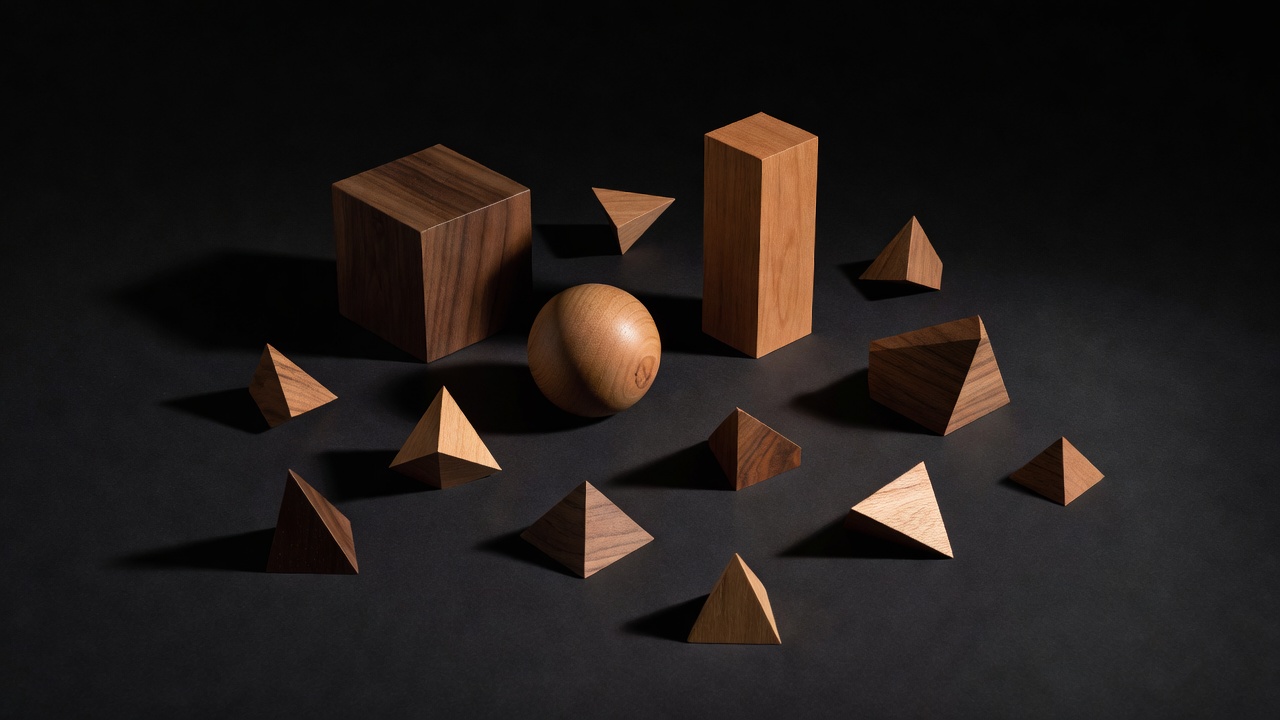
Tangrams: seven pieces, one fixed area
A standard tangram contains seven pieces, often called tans: two large right-isosceles triangles, one medium triangle, two small triangles, a square and a parallelogram. They can form a square and many other silhouettes. The familiar silhouette challenge uses every piece without overlap; whether pieces may be flipped should be stated separately.
Start by understanding the pieces rather than guessing a complete picture. If the original square has area 1, each large triangle has area 1/4. The medium triangle, square and parallelogram each have area 1/8. Each small triangle has area 1/16. These fractions add to 1, so rearranging the pieces cannot change the total area unless a piece is omitted or pieces overlap.
Try an area comparison
How many small tangram triangles have the same area as one large triangle? Does equal area guarantee that any arrangement will fit the same outline?
Hint: compare the fractions, then the boundaries
A large triangle has area 4/16. A small triangle has area 1/16. Area counts how much space is covered; it does not specify the shape of the outside edge.
Solution: four in area, not every arrangement
Four small triangles have the same total area as one large triangle. Suitable copies can be arranged to make that large triangle, but an arbitrary arrangement may have a different outline. Equal area is necessary for an exact replacement, not sufficient to establish that a particular arrangement fits.
Symmetry is a move you can check
A reflection flips a shape across a line. A rotation turns it around a point. A translation slides it without turning. Naming these transformations helps you compare arrangements without relying on “it looks about right.”
The tangram parallelogram is especially useful for this distinction. Rotating a physical piece within the plane does not reverse its handedness. Turning it over does. A silhouette may therefore require a flip under one set of rules and be impossible under a rotation-only restriction.
For a younger learner, trace the piece and try moving it back onto the outline. For a more experienced learner, describe the transformation and identify which distances and angles it preserves.
A chessboard no domino can finish
Take an ordinary 8 × 8 checkerboard and remove two opposite corner squares. Can the remaining 62 squares be tiled with 31 dominoes, each covering two squares that share an edge?
At first, the arithmetic looks promising: 62 is even. But counting total squares misses a stricter condition. Color the board alternately light and dark. Every legal domino covers exactly one square of each color.
Hint: compare the two color counts
Opposite corners of an 8 × 8 board have the same color. What happens when both are removed?
Solution: an invariant proves impossibility
The complete board has 32 squares of each color. Removing two same-colored corners leaves 30 of that color and 32 of the other. Thirty-one dominoes would cover 31 of each color, which cannot match the board. No arrangement can work.
This is an invariant argument: every allowed piece obeys a fixed color relationship. Instead of trying countless layouts, you find a property that rules them all out. Removing one corner of each color removes this particular obstruction, but it does not by itself prove that every such modified board can be tiled.
A condition can be necessary without being sufficient. Keep those two claims apart.
When a missing square is really a bent edge
The missing-square puzzle rearranges pieces into two figures that appear to be the same large triangle, with a small gap in one arrangement. In the familiar version, the apparent hypotenuse is not a single straight line. Component triangles have different slopes, so the boundary bends slightly inward or outward.
The area has not disappeared. The subtle difference along the long edge accounts for the gap. A photograph may conceal it, which is why precise coordinates, a straightedge or a slope calculation are more trustworthy than the overall impression.
Henry Dudeney’s The Canterbury Puzzles and Sam Loyd’s Cyclopedia of Puzzles belong to the long tradition of geometric recreations. Euclid’s Elements represents a different but connected tradition: making relationships explicit enough to justify a conclusion.
For further hands-on investigations, explore NRICH from the University of Cambridge. Then carry the same habit of checking into number games.